
I was asked this by a friend who has a progressively enlarging non-toxic goitre and a CT scan that showed a huge multinodular goitre with tracheal compression: do I need surgery and why? Should the whole thyroid be removed or can some be spared?
My quick answer was YES you need surgery, and a total thyroidectomy, both because of the risk of occult carcinoma. An FNAC can easily miss malignant foci, MNGs have a risk of malignant change, imaging has no reliable sign of malignancy, and compression heralds worse complications (with or without op).
But what's the risk exactly, and what does evidence say about how much of thyroid to remove? This is what the evidence says:
1)In a review of 317 patients operated for multinodular goiter, the incidence of occult micro-carcinoma was 3.3% (Wahl RA, Goretzki P, Meybier H, Nitschke J, Linder M, Roher HD. Coexistence of hyperthyroidism and thyroid cancer. World J Surg 1982; 6: 385-390)
2) Another review of 98 total thyroidectomies done for MNGs revealed an incidence of 10 cases (10.2 percent) occult carcinomas - seven patients were diagnosed with papillary carcinoma, two with the follicular variant of papillary and one with follicular carcinoma.
http://www.ispub.com/ostia/index.php?xmlFilePath=journals/ijs/vol17n1/goiter.xml
2) Total thryoidectomy may avoid need for reoperation in case of incidental thyroid
cancer; a study of 218 patients with euthyroid multinodular goiter and no suspicion for malignancy were randomized to total or near-total thyroidectomy (remnant tissue < 1 g) vs. bilateral subtotal thyroidectomy (remnant tissue> 5g); no significant differences in rates of temporary unilateral vocal cord dysfunction (0.9% vs. 0.9%), hypoparathyroidism (1.8% vs.0.9%) or finding of papillary cancer (9.2% vs. 7.3%) (Arch Surg 2004 Feb;139(2):179 in JAMA 2004 May 5;291(17):2058)
So, with a risk of somewhere between 3-10% occult carcinoma (papillary still being the commonest) and near-total also mean could-miss; I think it's still right to say MNGs should be treated with total thyroidectomies unless surgically difficult; upon which post-operative suppressive thyroxine may be an option.


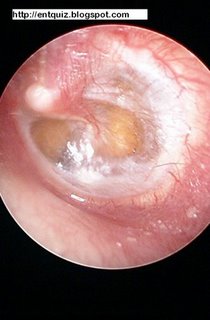 'Heavner et al., in two animal studies, have demonstrated that exposure of the eustachean tube to simulated gastric content in rodents creates eustachean tube dysfunction. Velepic et al., in two separate studies, have demonstrated a strong correlation of otitis media and GERD. Using a 24-h double pH probe, they found that approximately 60% of the patients had pathologic GERD. In a 2002 study, Tasker et al. demonstrated that middle-ear effusions taken from 54 children contained pepsin/pepsinogen at concentrations up to 1000-fold greater than those in serum 83% of the time. These data suggest that the reflux of gastric juices could be a major cause for otitis media with effusion in children. The link between otitis media with effusion and pharyngeal reflux was further strengthened in a 2004 study by Keles et al. This dual-probe pH study demonstrated that 48% of the children with chronic otitis media effusion had GERD and 64% of the children had pharyngeal reflux. This study suggests that pharyngeal reflux may play an important role in the causes of chronic otitis media with effusion and also that standard single-channel pH probes evaluating for gastroesphageal reflux frequently will miss pharyngeal reflux.'
 Should we blame everything on GERD? The above discussion, excerpted from
  A 55yr-old man had craniectomy and drainage for a huge intracranial temporal lobe abscess and an ipsilateral extracranial temporal abscess as seen in this CT scan. He was referred to ENT for clearance of a possible foci of infection from the mastoid or middle ear which would seem to be the case from the 2nd image presented here. A large area of erosion is seen in the mastoid, communicating with the middle fossa as well as the temporal space.


 Posts
Posts


